

Interviews with Marketers: Jacqlyn Marcus

Jacqlyn is Senior Director, Marketing, Alliances and Professional Services at Valeyo, a Canadian-based provider of lending technology and insurance related products and services for financial institutions nationwide. She has (thinking reflectively) spent most of her career in the financial services space building relationships, brands and stories. When not at work she’s an avid reader, generally having multiple books on the go at any given time. In 2022, without any real training or camping experience (eew, bugs) she completed the infamous 75km West Coast Hiking Trail on Vancouver Island, in an invigorating 4.5 days. Only one bear was spotted. None were harmed.

Can you describe your approach to marketing?

I am focused on driving marketing activities that support trust and build deep relationships with our clients, partners and industry, because I work in a market that values these qualities. Our audiences want to be spoken to in an authentic and customized way, and they don’t have time for generic messaging that isn’t relevant to their immediate business strategy or concerns. This means creating content geared to the individual and ensuring the narrative that matters to them is front and centre. It also gives clients awareness of what we’re doing and what we can do for them. And that transparency further helps build trust.

What have the last few years been like for you as a marketer? What has this meant for your marketing team and strategy?

Well, the last few years have been difficult for everyone. Thankfully, the organization I work for is very supportive of marketing and the value we bring to the business. One of the ways we pivoted was by outsourcing less and bringing more creation in-house – video content creation is an example of that. First, because we couldn’t go into a studio or meet in person. Second, because it makes good financial sense to build a strong in-house marketing function. This allows us to be more responsive and agile and to scale up or down as needed. Companies of all sizes rely on some level of external support (as we do with HeadStart Copywriting), but we also looked at using any downtime to take courses and build new skills that would provide the greatest value and return to the organization.

What advice would you give someone just starting out in marketing?

There is great benefit to working in a smaller company. Many younger employees want to work for big companies, thinking it will be more exciting and rewarding. And that’s possible. But in a smaller company, you can try your hand at different marketing streams and be fully involved in the end-to-end process from day one. That experience is invaluable. And when you’ve had that exposure, it makes your skills more transferrable, and it becomes easier to determine where you want to specialize as you grow your career.
 
The second piece of advice I’d give is to learn as much about your company’s business as possible. Speak with colleagues outside your team and department, and volunteer on committees or for special projects. As you learn about the business, you’ll be able to see opportunities to grow within your role, which will also allow you to grow outside of your role. 

What are the most valuable tools in your MarTech stack?

Email marketing is essential to us and has given us the best ROI. It’s simple to execute, and our content often has an average open rate of between 25%-40%, which is much higher than industry standard. Traditional ads are less successful for us, but we invest in a bit of digital advertising to keep our company top of mind. When you have smaller budgets, it’s important to find the marketing mix that can help you succeed by being present with your target audiences. LinkedIn is also necessary for organic growth and promotion because that’s where most of our customers are, and those who influence our customers.
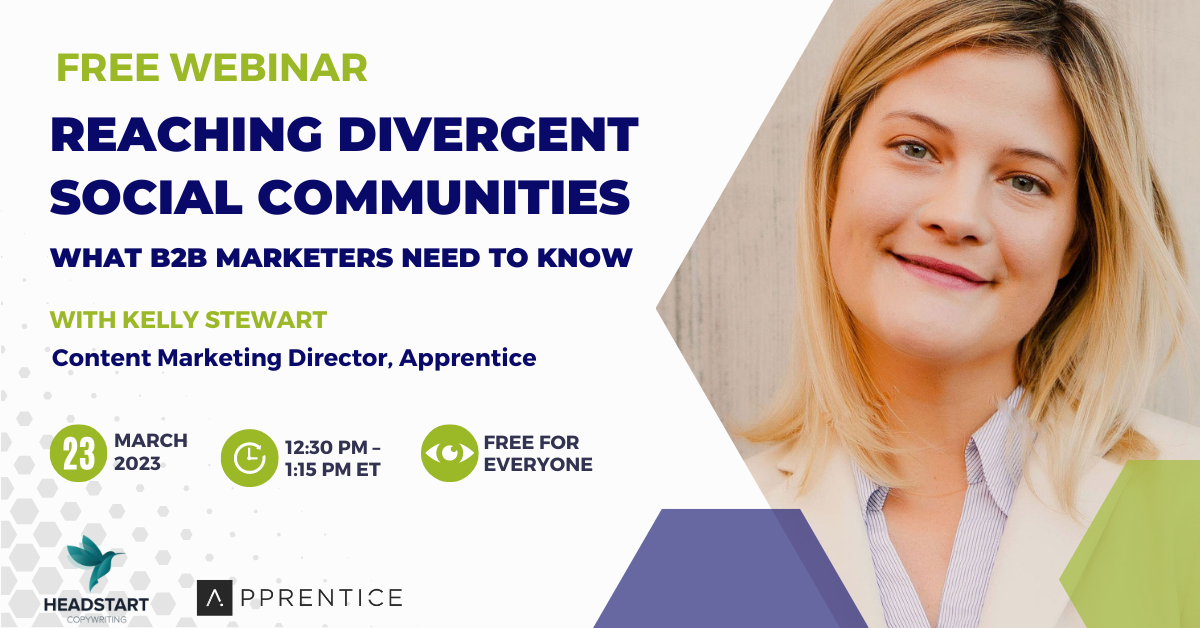
Reaching Divergent Social Communities: Free Virtual Session

HeadStart Copywriting is hosting a free virtual session for B2B Marketers who want to reach different and/or specific audiences in various communities, seemingly scattered online in “divergent communities”.

In this free virtual session we will be spending 45 minutes to discuss strategies on reaching divergent communities in B2B marketing. What are “divergent communities?” and why do B2B marketers need to learn about them? Come join HeadStart Copywriting and our guest speaker from Apprentice explain how you can be ahead of the curve (and where your customers are) with new and/or further knowledge on divergent communities. Visit our Eventbrite page and sign up to join our free virtual session on March 23rd at 12:30pm EST.


About Our Speaker

Kelly Stewart, Content Marketing Director, Apprentice.io

Kelly Stewart has more than a decade of content marketing, content strategy, copywriting, and advertising experience. Her work spans a variety of industries including B2B, SaaS, AR, tech, and healthcare. Holding dual degrees in Astrophysics and English, Kelly bridges the gaps between technical expertise and consumer interests by bringing brands to life through powerful, persuasive content.

By focusing on the way words will be consumed, the typography, information architecture, and content density, Kelly focuses on the reader’s content experience – the person behind the buyer.

Kelly’s ultimate goal is to challenge the assumption that scientific discoveries lay outside the realm of public discourse. Her method? Destroying all the jargon that crosses her path. If she can’t reframe a complex topic to be clear and engaging to readers of all backgrounds, that’s a sign for her to keep on studying it until she can. Astounded and inspired by the raw power of language, Kelly adopts Pablo Neruda’s simile, “poetry is like bread”, and seeks to unmask the poetry of everyday life for others and write words that feel as nourishing as freshly baked bread.

~~~~

Please register for a free ticket at our EventBrite page and you will be emailed the Zoom link the day before the event. 

We reserve the right to record this event and to produce our own marketing materials based on the content, and may seek out the permission and review of the panelists and participants.

Interview with Marketers: Sarah Koval

Sarah Koval is a Customer Marketing Manager at Algolia. She graduated from The College of Charleston with her degree in Marketing. Sarah started her career in tech sales, and has since transitioned over to marketing, utilizing her customer-facing experience to specialize in customer advocacy. When not working, Sarah enjoys spending time with her family and cat, Gravy, as well as baking delicious desserts. 

How vital is customer-focused marketing to what you’re doing right now?

Customer-focused marketing is my primary role at Algolia, so I focus on creating and maintaining relationships with our customers and often liaise between our marketing and sales departments to support that role. That’s one great benefit of having a sales background because I knew exactly what I needed when I was in sales and had a direct line of communication with my customers. And now that I have the chance to produce the things our sales department needs, I find it beneficial to always have those needs at the front of my mind and follow the direct line back to the customer to determine what they’re really asking for.

What do you do to create a stronger connection between the two departments?

Well, we have to work cohesively, but we don’t always see eye to eye. I think that that’s a bit of a benefit of having sales experience and then moving over to marketing so that I understand what our sales team needs. Ideally, marketers should be able to understand the sales perspective and anticipate those needs. Those needs differ in that sales departments tend to expect everything to happen immediately. Partly, that’s because a sales team may not see how long marketing campaigns take because of the various approvals and stages a campaign moves through, but I can help them understand our strategy and they can help me connect with what our customers are looking for.

It helps to get to know your main points of contact in sales. Once you get to know people, it becomes easier to ask specific questions and hone in on common goals to build rapport and excitement between departments. I try to keep in mind that both departments are working towards similar, overarching goals and remember that you always have to bring it back to the customer. They’re the ones who got us there. We have to work together to build them up and get them excited about certain things because customers sell my product just as much as I did when I was in sales.

What are important traits for new marketers?

I think you have to be persistent. Don’t be afraid to ask for what you want. Don’t be afraid to pick up the phone. Persistence is something that propelled me forward when I was in sales and does within marketing, too. Persistence and strength. I come back to the word “grit” a lot because pairing persistence with grit is probably the combination that’s been the most useful for me.

It’s also important to remember not to compare yourself to other people. Because you’re on your path and you will get where you want to go if you stay focused. 

What are the most valuable tools in your MarTech stack?

Many of our tools are customer-centred and allow us to engage and maintain connections in and out of house. I use Salesforce and Slack to keep connected to our sales team and, through them, a direct line to customers. Jira keeps everything organized in house so I can reach the people I need to, even if it’s just to chat over coffee and connect that way.

We also use partner channels within Slack that let our customers communicate directly with our sales team, and anyone involved in account management will also use that channel. It’s a great way to get on top of any issues and gain insight directly from the customer. And, of course, we use Marketo quite a bit to get campaigns out.

Interviewing without all the prep!

Podcasts, webinars, panels, firesides: people are constantly interviewing other people! And while you might think it’s exhausting to curate an engaging conversation, it doesn’t have to be.

Over time I have developed my “no-prep” approach to interviewing others. It helps people feel comfortable and at ease to discuss what they are passionate about.

  1. Do not prepare custom questions or send questions in advance to your guest.
    Your own questions can feed biases and make them talk about what you want. You want encourage authentic spontaneity and a more lively discussion.

  2. Uncover what your guest wants to discuss by asking open-ended questions.
    Open-ended questions allow your guest to drive what they want to say.
    There is no prep required from you or your guest using this approach. All they have to do is show up and talk about what matters to them.

    Sue’s favourite “no prep” questions in recommended order:
    – If someone invited you to speak at an event, what topic would you talk about?
    – Tell me about your background.
    – What advice do you have for others just starting their career?
    – What has brought you success in building your career?
    – What do you want to be known for?

  3. After you ask one of these questions, be silent.
    Embrace the natural silence that follows the question. We are all naturally inclined to speak to fill that void; it takes practice to push back on the urge. But if you let silence flow, your guest will fill it with personal insight. Let their passion talk.

  4. Ask follow-up questions during the interview.
    – Why did you want to learn the skills/expertise you mentioned?
    – Why are the skills/topics/expertise you mentioned important for others?
    – What examples can you tell us about?
    – Based on that, what do you want others to know?
    – Why?
    – What else?
    – Can you provide an example?
  5. Bonus Tip from Lawrence Cummer, one of our writers…
    Drop your ego. Be curious but leave your ego behind and “forget what you know.” Your guest’s insights are what you’re after.

  6. (Optional for blogs) Based on the interview answers above, write the questions and organize their responses to create a draft.
  7. (Optional for blogs) After the interview, ask the guest to review the questions as well as the answers.

~~~

Photo credit: Andrea Piacquadio 

Interview with Marketers: Matt Fish

Matt Fish is a Senior Product Marketing Manager at Fortra’s Terranova Security. He is also a writer and content creator striving to educate, inspire, and provoke more profound thought and discussion about business, marketing, branding, leadership, technology, pop culture, and creativity.

As a copywriter and editor, Matt crafts blog posts, headlines, ad copy, webpage copy, eBooks, video and voiceover scripts, social media posts, and much more. He loves writing concise, engaging content that will grab consumers’ attention and help them build an emotional connection with a brand.

From your perspective, what is the most important thing marketers need to know about writing?

The most important thing is having high communication and editorial standards: to set high standards for written content. By setting high editorial standards, not simply for grammar, spelling, etc., but with voice and tone and how engaging your work is, you’ll be able to rise above most of the online content, which is so beige it never speaks to people consistently.

Most consumers are tired of constantly seeing cookie-cutter content, and the volume of repetitive content has caused people’s BS meters to be higher than before. This sentiment will only become truer as more content creators leverage AI to write their content for them … yes, the technology is exciting, but AI is basically scraping already-published work and repurposing it to put in your brand’s mouth. You’re no further ahead in avoiding the BS meter’s alarm.

Why is it that good writing, integral to generating growth for an organization, isn’t always accepted as a fundamental truth?

So much of how an organization operates, from describing what the brand is to the marketing of that brand, hinges on written content: website pages, social media posts, and email campaigns. Written content becomes an afterthought. Enterprises will often invest in everything before they invest in content because they think creating written content is easy (it’s not).

The concept of writing for a market (or marketing) has become a full house, diluting its importance. But at its core, marketing is responsible for two things: increasing brand awareness and generating leads. Good writing is essential to the success of those goals. 

When you’re considering the importance of content or copywriting in general, think about how many visitors go to a website or eCommerce store and can’t find what they’re looking for – not just from a “what is it” information aspect but an emotional “feelings that resonate with me” aspect. Then, think about much money a brand leaves on the table by not investing in copywriting that pushes visitors to convert instead of simply clicking away. (Marketing isn’t responsible for closing deals: that’s a sales team’s job; marketing isn’t responsible for detailed product assessment: that’s a product support team’s job.)

Why do you think organizations aren’t willing to invest in writers?

The assumption is that all writing is the same. But this is not the case – writing an email is not the same as creating content for a landing page.

The assumption is that writing is easy and anyone can do it. Many organizations relegate writing low down on the scale of what’s essential. Because they often house writers within other divisions, there is little to no investment in the actual craft of writing content. 

Is it possible to change and help organizations recognize good writing as a critical factor leading to their success?

Organizations need to shift their focus and appreciate writing and marketing as skills that require the same dedication and support as other industry skills.

It is crucial to build on the understanding that even hugely successful organizations – those that are household names – got to where they are primarily through good writing. Organizations that invest in good writing know it’s a marathon, not a sprint. This idea also applies to the industry valuation of writing. 
To prove how important writing is, writers need to illustrate the specifics of that growth: quantify and confirm. Analytics provide proof that organizations need to invest in writing.

My advice to marketers and writers who struggle with proving a content’s worth is to tie it back to business objectives. How many leads did this webpage produce last month or year? How much traffic was converted into sales opportunities because this landing page performed so well? Business is about making money, so tying creative work to business objectives gives it automatic validation, especially in a room where creatives may not always be present.

There is often the assumption that a successful marketing campaign must be unique to grab attention. What is your point of view?

Uniqueness doesn’t have to triumph all the time because uniqueness is, practically, besides the point. Most good marketing content isn’t created in a vacuum. It builds and evolves on what’s worked before it. Many of the same best-practice principles that writers used in the 60s and 70s (David Ogilvy, as one example) remain the same: read as much, watch as much, and learn as much as possible about writing, and about writing as marketing.

Industries do not make this easy: unfortunately, many marketing departments are go, go, go. This leaves little time to generate ideas that are fresh interpretations of tried-and-true formulas. Buzzfeed as an example: clickbait is such a negative term, but a lot of successful writing that leads to action is essentially clickbait. Well-written content should be clickbait. You want those clicks.

What is your MarTech Stack?

  • Semrush and Ubersuggest for SEO optimization; Ubersuggest is less expensive, great for getting started, and includes a lifetime pass.
  • Google Analytics is invaluable for website and traffic insights. Learning how to use it above a rudimentary level is essential, but there are free tutorials that can break it down.
  • Grammarly (Pro version) is the best money any marketer will spend. The free version isn’t usually worth it as it’s very similar to what the average word processor will offer, but the premium version is.

Interview with Marketers: Alicia Gordon

Alicia Gordon is a results-driven communications and marketing leader with 15+ years of agency and corporate experience. Having begun her career as a general assignment news reporter for a local cable station in midwestern Ontario, she draws on a wealth of varied experience. Storytelling is her superpower, and she delivers bold strategies, ideas with impact, and leads high performing teams from idea inception to completion. 

Currently, Alicia is Director of Global Content at Colliers, a leading diversified professional services and investment management company. Partnering with global business line leaders, as well as brand, digital, and creative teams, Alicia leads integrated marketing and content strategies and plays an important role in developing content that amplifies the Colliers brand.

Why remain a generalist in a field of specialists in marketing?

Although specializing in a subject area equips professionals with a degree of authority, I don’t believe specializing is necessary for success – there is power in being a generalist. Understanding many things well, but not at an expert level, gives someone the ability to use their high level understanding to create the right tone of voice for content.

To be a successful generalist, not only do you have to understand what it is that you do well, but also what members of your team do well to better support your marketing approach. Finding this balance is, in part, what drives my desire to build community and maintain connections within any organization I work in. This has become trickier with the new norm of remote working, but by leaning into both colleagues and friends in the industry, I can leverage my connections for success.

Why is self-awareness important as a marketer?

Being self-aware allows me to listen to my inner voice and take informed risks, in order to be successful. I can fuel my strengths by taking the time to understand myself and my own drivers and goals. It’s also really important to trust those on my team, and foster dialogue and debate to help create new ideas and build on existing ones.

I really want to work with colleagues who stand behind their beliefs while accepting other viewpoints. Ultimately, an inclusive environment is key to helping my team collaborate and a single perspective is not enough to move ideas forward. I’m also a firm believer that no idea is a dumb idea, and it’s important to make sure different voices are heard and respected.

For content creation, why is less sometimes more?

I like to take a less-is-more approach to content creation by developing fewer more impactful campaigns that have a longer shelf life. This approach also tends to extend the life of an asset, while campaign details can be tweaked across various platforms, audiences, and internal and external communications. 

What is your MarTech stack?

I often use tried-and-true B2B tools, like LinkedIn. Collaboration is also key and I lean into colleagues with specific expertise in areas that I may not have. Data is also a powerful tool that can create valued insight, measure impact, and ultimately drive marketing activities. 

Interview with Marketers: Tricia Reynolds

Tricia Reynolds is a content strategy director at Genesys. She has a master’s degree in public relations and experience in a variety of marketing roles, including product marketing, digital marketing and community relations. When not working, Tricia enjoys spending time with family and friend as well as leisure bike rides and curling up with a good book on a rainy day.

What’s your top takeaway about content strategy and marketing?

At Genesys, success is like a three-legged stool: it’s a partnership between product marketing, content marketing, and demand generation. Every campaign needs those three people at the table. And just like the stool, which falls over when a leg is removed, each role is essential. If demand generation isn’t there, content might just sit unseen on our website. Without product marketing, we can’t be sure that the content ties back to our products. And without content marketing, there’s no guarantee that emails will be read or that the company’s message will be understood.

As a marketer, how do you work with other people to create the perfect content?

You have to be intentional about teamwork because often, people want to be quick. They just want to  get something done. But if some team members aren’t there, what happens to the quality? But the other side of the problem is that it’s easy to invite too many other people into the conversation, especially when you’re at the beginning of the process. It’s not that all those opinions aren’t valid! But once you start adding in more people, plans start to get convoluted. It almost becomes scope creep. With so many people involved, it’s much harder to address the biggest single problem.  

As an example, we sell through partners, but we have both direct and indirect channels. And when we talk about a campaign, the sheer number of people involved in those channels means that setting up our demand gen team can be challenging. But when we establish the demand gen side of it first, and when we’re clear about what the product is and what story we’re going to tell customers, the next steps are much more straightforward. Then, it’s easier to tweak things and make them work for everybody. Having the foundation in place at the start is essential.

What advice would you give to someone thinking about a marketing career? Is there a particular type of marketing that you advocate for?

I’m a huge fan of B2B marketing in the tech world. It’s new, it’s always changing, and every day you encounter new technology. And of course, everybody wants to sell to you! I have a daughter studying marketing in university, but her courses focus on more traditional aspects of marketing, like advertising and direct marketing. Maybe I’m a bit snobby about that, but it sounds so basic. Marketing directly to people is easy – try marketing to someone about their customers. It’s that additional step where I’m trying to tell this person to buy something, so that someone else can benefit. And that’s where the challenge is. Of course, I’ve encouraged my daughter to learn as much as she can in her classes, but I’ve also urged her to do some self-education and go over to HubSpot and learn more about B2B tech marketing. It’s evolving so fast, just like technology. When you’re in marketing, you need to be prepared for change, and you need to build that into your career.

How do you stay on top of trends?

It’s almost impossible to stay on top of everything – that would be a full-time job all on its own. So, I turn to my teams. Whether it’s demand generation or the SEO team, I rely on our experts to share trends. I ask a lot of questions and I bring them into the conversations about projects.

What websites do you use most often?

SEMrush is one site that I visit a lot, and our website teams use their tool to develop the SEO terms for the site. I also use HubSpot, and I like that it doesn’t go too deep. When I have questions, I can almost always find the answer there. I especially love that they make their content freely available. That’s a conversation we often have with the demand gen teams: how much information should we give away, when we still need to meet our targets?

How do you set that balance between making content available and gating it?

For us at Genesys, it’s about value. I always say that when somebody fills out a form and gives you their contact information, they’re buying something. We want them to feel good about that purchase. But what are they paying for that content? Is it five to seven emails, and probably three phone calls? Will they end up on a newsletter distribution list? I want people to know at the outset what to expect, but even more importantly, once they’ve read the content, I want them to feel like they got a great deal.

From an SEO perspective, what do you think marketers should pay attention to?

From a content marketing and strategy perspective, one of the things I’ve tried to be very intentional about is to think about the marketing purpose for the Genesys content that we’re creating. We spend a lot of time focusing on the buyer and the tasks that they perform on their buying journey. But there are also tasks at Genesys that affect what we’re trying to achieve. For example, there are two separate sides to our demand generation team. The outbound team works on getting content out there. They’re all about pushing out the content and getting eyes on it with emails, syndicated content, and paid ads. And then there’s the SEO team, which draws people in. But when you look at those two functions, and the type of content you create, often you’ll find that the content only meets the needs of one of those teams.

For example, a gated .pdf is not going to rank very well for SEO compared to a great piece of thought leadership that’s freely available. But if you’re going to take a piece of content and put it out into the syndicated channels, today’s technology means it has to be a .pdf. These two things are like oil and water: once you create the .pdf, you’re limiting some of the opportunities for it to get expanded use and SEO. And vice versa: if you create a great ungated article and put it on your website, you lose the opportunity to use it for syndicated content. It’s important to find the right balance.

It’s easy to get caught up in the immediate numbers and results, but it’s important to keep your eye on the bigger picture. For example, when you create a gated .pdf and a lot of people start reading it because we are promoting it heavily, you’re going to get big numbers at the start, and that can sometimes be misleading in terms of how well the content will perform overall. The same thing is true when you create an ungated web article, because it takes time to generate SEO activity.

Of course, the goal is always to have those rockstar pieces of content that perform well all the time, but in most cases, you can only put so much money and effort into each piece, and then you have to move on to the next one. It’s about finding a balance. If the strategy is right at the start, if you put your money behind the right pieces of content, you’ll see results quickly. At the same time, your SEO articles are starting to gain traction, so Google starts to recognize your pieces as the authority. Then, when the outbound campaigns start to tail off, the SEO starts to pick up. That’s how your numbers can stay steady over time.

Interview with Marketers: Daniel Person

Daniel Person is Senior Manager of Content Marketing at Icertis, the contract intelligence company that pushes the boundaries of what’s possible with CLM. Prior to joining Icertis in 2018, Daniel spent 10 years in journalism, working for newspapers across the Western U.S., and publishing work in regional and national outlets including The Guardian, Outside, and High Country News.

1. What was it like to transition from a journalist to a marketer?

It was like stepping into a completely different world. All the jargon I was accustomed to: ledes, graphs, heds, were replaced with an entirely new vocabulary: KPIs, ROI, TOFU, etc. But in a way I think journalism made me a good listener and learner for exactly a situation like this. A journalism colleague of mine once said that one of the realities of the job was that, often times, you would cover a meeting where you were the least informed person in the room, and yet you were the one who had to write about it on deadline! That kind of pressure makes you good at staying comfortable in situations where you might not have all the information, and listen intently to pick out the data you need to make sense of things. Over time I could make more and more sense of things, and within a month I was talking a lot about KPIs 😊.

2. What skills as a journalist have you transferred to marketing and how effective has it been?

The skill I was hired for was writing, and that transferred pretty seamlessly. Journalism is a deadline business, so it trains you to be able to crank out lots of copy with not enough time do it. But what I found to be even more valuable, in the long run, was my journalistic ability to tease out stories and narratives from a lot of noise. As I noted above, journalism makes you a very good listener, and I like to think journalism gave me the skills to listen to my peers—many of whom are experts in their fields and fonts of knowledge—and translating their insights into accessible marketing material for the company. It’s been a privilege to get face-to-face time with our CEO, CTO, and other leaders to gather their thoughts for content, and over time, I’ve become a bit of an expert about the company myself—very similar to the way a good journalist eventually “owns” their beat. That’s helped me show leadership in our messaging and positioning, which goes well above beyond “copywriting.”

3. Why/how can other marketers benefit from a journalist’s mindset or approach?

I would encourage marketers, especially content marketers, to approach their jobs with an enterprising spirit. The content that the business thinks it wants may not be the best content you can deliver. Think about how you can “break” a story about your product or service that changes how people think about it. Of course you need to stay aligned with broader messaging and positioning strategies, but there is a real opportunity in content to show leadership around how the company communicates its value and its impact.

4. What is your MarTech Stack?

For me it’s all about Microsoft Word and PowerPoint! When you have the power of language on your side, the tech isn’t too complicated 😉.

Starting Out as an Entrepreneur?

These tips were featured for an International Women’s Day talk in March 2022.

  1. Pay yourself as well as your team.

  2. A shareholder agreement is critical when incorporating with someone else.

  3. Money is everywhere, profit is not.

  4. Recurring revenue and retention bring more profits than new revenue.

  5. Accounting is not finance. Craft your accounting codes to give you good financial information.

  6. Be thoughtful about overhead, overhead is required to build a capable company.

  7. Company culture comes from everyday interactions, how we help team members, and celebrating the little things.

  8. Investors and venture firms generally have only two ways to get their money back – a company sale or IPO.

  9. Persistence and unwavering family support give you the time you need to build a profitable company.

  10. Deliver what you have promised, when you promised it.

———–

My initial idea came about when I asked myself:

Why do writers have to sell all the time to keep their workload steady? Why do companies have to negotiate terms every time they need one thing written?

Inspiration?:

Software as a Service: why couldn’t we do that as writers and scale like a tech company?

Challenges faced as a female entrepreneur?:

Nothing direct but definitely not being seen, not recognized in “prominent” entrepreneurship circles. It is worse when you provide a service. Services are not seen as scalable and women are more likely to start service-based companies. Product and tech product companies get more recognition overall.

Photo by sergio souza from Pexels